
Read an Alæc response
Understand response structure and continue the exchange from the same screen.
In this article
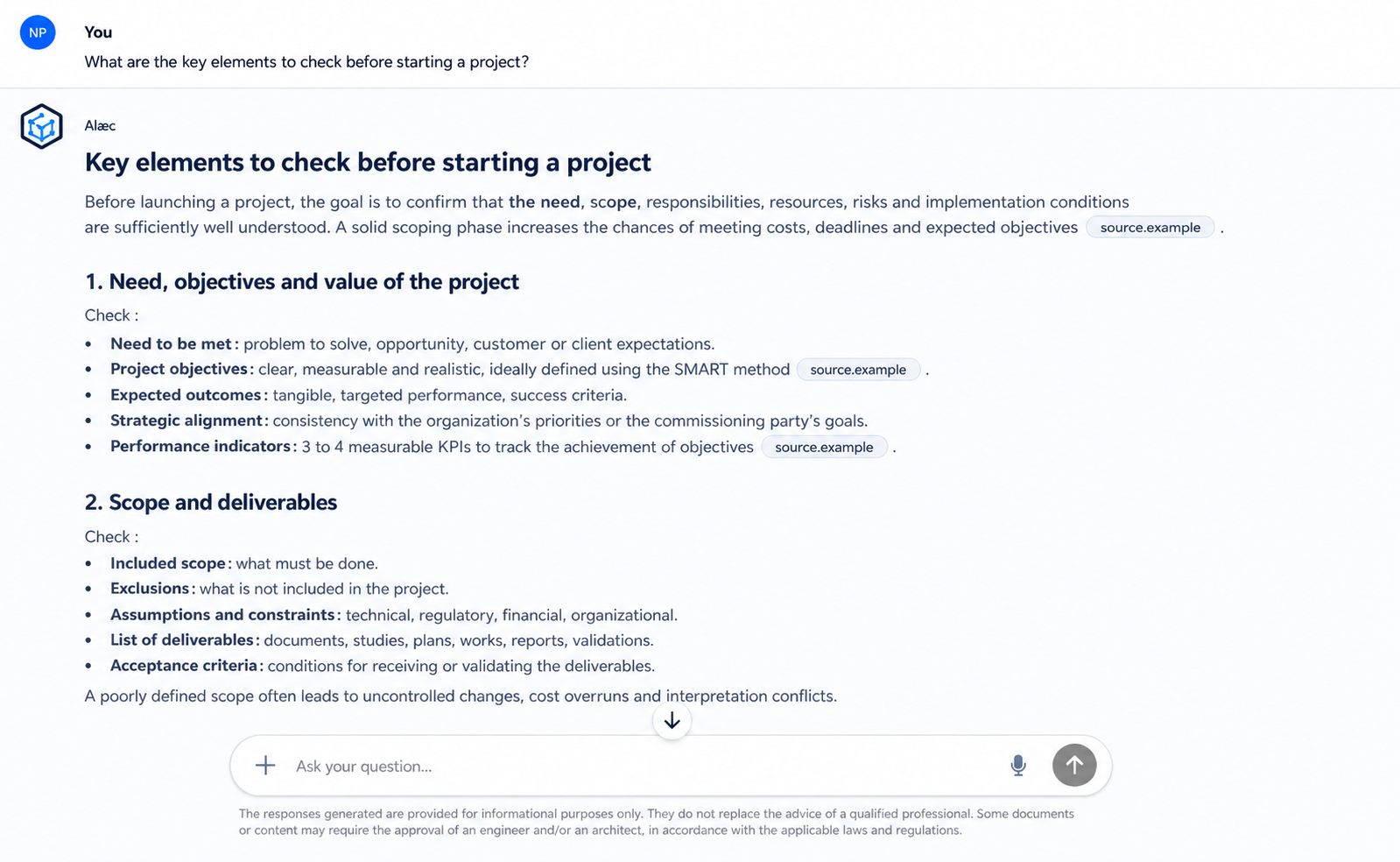
A response can contain headings, lists, and a short response or summary depending on the content produced. The composer remains available at the bottom so you can continue the conversation.
- Scroll when the response exceeds the screen height.
- Use the same conversation to ask for clarification.
- Start a new chat if you completely change topics.
Distinguish content from evidence
- Direct answer
- It states the proposed conclusion or recommendation; verify that it actually answers the request.
- Explanation
- It presents reasoning, steps, or criteria; identify assumptions that could change the result.
- Sources and references
- They let you return to original documents. Confirm that each source supports the claim it accompanies.
- Limits
- A missing source, uncertain data, or absent information should be treated as something to verify, not as confirmation.
Verify before acting
Compare the response with the request’s objective and constraints.
Separately verify names, dates, amounts, units, citations, and recipients.
Open original sources when available and check their version.
Request a specific correction for each discrepancy instead of a general rewrite.
Obtain required approval before using the response in a decision, document, or external communication.
Practical guidance
Distinguish a finished answer from activity feedback, a pending tool result or an interrupted turn. Source references, generated images and document links may have their own states. A visible paragraph is not proof that every requested operation has completed.
Advanced tips
For a response with several recommendations, verify one claim at a time against its cited source. Ask for a targeted correction that preserves accepted sections instead of requesting a broad rewrite that makes comparisons harder.